MIT Called It a Second Brain. We Built One: Memoket Gem
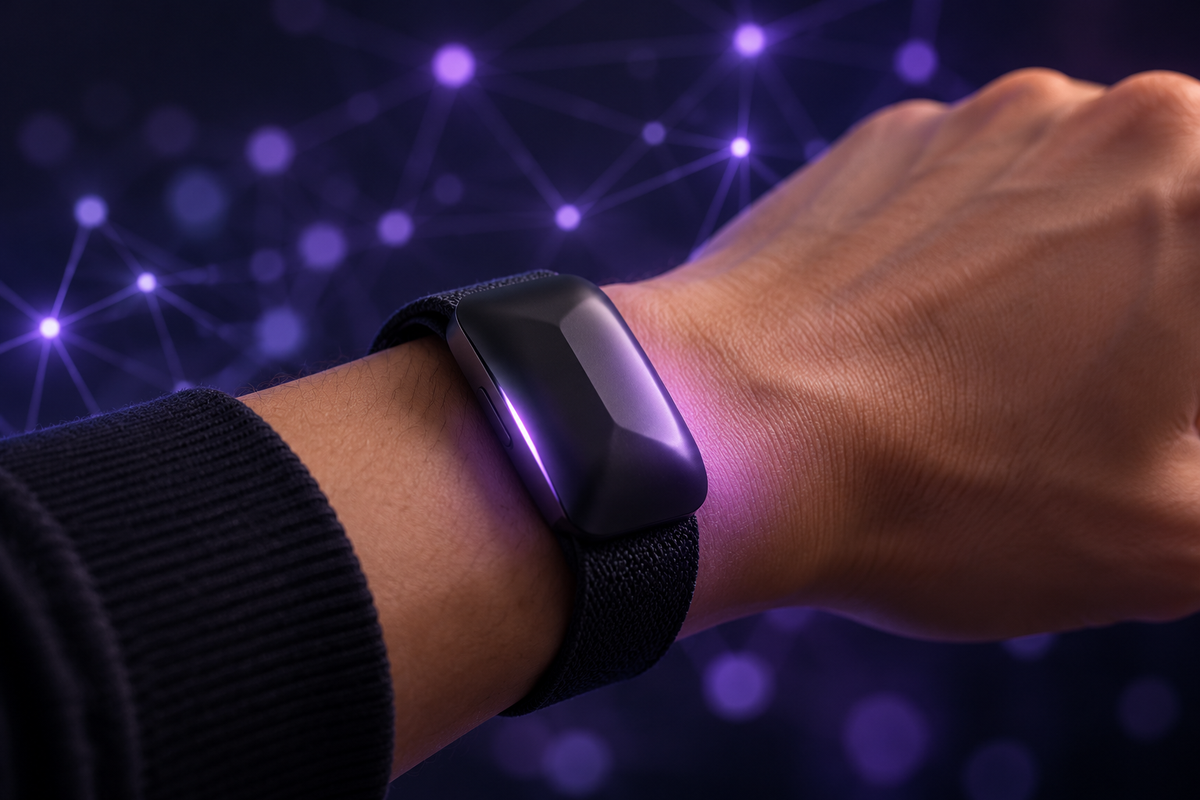
Researchers at MIT's Fluid Interfaces group built a wearable prototype that listens to arguments in real time and tells you whether they're backed by evidence. They called it a "second brain," an extended reasoning organ that could, over time, make people more rational. That project never became a product. We think about it a lot.
When we were designing what would become the Memoket Gem, we kept returning to a simple question: what does it mean for a device on your wrist to actually make you better at your job? Not just capture what was said. Not just produce a transcript. Make you better: smarter, faster, more informed, in the moments that count.
The MIT research gave us language for something we already believed. A wearable personal agent is not a recorder. It is not a note-taking app you wear. It is an extension of your cognitive capacity, running continuously, feeding structured context back into the decisions you have to make.
What MIT's Fluid Interfaces group found

The Wearable Reasoner project tested whether a wearable device could improve human reasoning by providing real-time feedback on the quality of arguments. Participants were exposed to claims on socially divisive issues and asked to rate each one for agreement, perceived reasonableness, and their willingness to act on it.
When the wearable explained why an argument was or wasn't supported by evidence, rather than just flagging it, participants changed how they evaluated what they heard. They agreed more with well-evidenced claims. They rated them as more reasonable. In interviews, they described integrating the AI's feedback into their own judgment, valuing having a second opinion running alongside their thinking.
"A wearable system capable of identifying whether an argument is stated with evidence or not."
The researchers were careful about something that mattered to us: they distinguished between explainable AI feedback and opaque AI feedback, and found that explainability was what actually moved the needle. A black box that says "this claim is false" doesn't help you think better. A system that shows its reasoning gives you something to work with. That distinction shaped how we think about MemoChat.
The second brain idea, taken seriously
The phrase "second brain" gets used loosely to describe anything that stores information: a notes app, a bookmark folder, a wiki. That's not what the MIT researchers meant, and it's not what we mean when we use it.
A genuine second brain doesn't just store. It processes. It surfaces the right context at the right moment. It connects something said in a meeting today to a decision made three weeks ago. It notices that the concern a customer raised on Tuesday is the same concern, phrased differently, that a different customer raised in August.
Keeps a record of what was said, in the order it was said. You retrieve it by searching or scrolling.
Connects what was said to everything else that's relevant: other conversations, decisions, patterns. It surfaces that context when you need it.
The gap between those two things is large, and most wearable AI products live in the first column. They record well. They transcribe well. They stop there.
The MIT research established that a wearable can actively improve the quality of human cognition, not just capture it. That's the thesis we built Memoket around.
From proof of concept to wearable personal agent
Memoket Gem is a wearable personal agent. It records conversations with a single button press, works alongside your Apple Watch or on its own band, and feeds structured context into the tools you already use. But the hardware is the easy part to describe.
The harder part, and the one that connects to the MIT research, is what happens after the recording ends.

Every recording in Memoket becomes searchable, linked context. It can surface what was said in past meetings when you're preparing for a new one. The report engine can draw an action plan, a decision matrix, or a project timeline across every relevant conversation in your library by connecting all this context to the AI tools you already use like ChatGPT, Claude, Gemini, and many more. It can compare what three different job candidates said across three different interviews and give you a structured comparison table, not a list of transcripts, but a synthesis.
Behind this is KITE, our long-term memory engine. KITE connects recordings across dates, meetings, and projects. It's what turns a library of isolated conversations into something that behaves like continuous memory: the thing that lets Memoket answer "what's actually going on with this deal" rather than "here's what was said in six separate calls."
The MIT researchers identified the right goal. KITE is how we're pursuing it.
If you want to go deeper on how memory works in people and in AI, our engineer Kris Tan wrote a full breakdown: Memory Anatomy →

We also thought hard about the explainability point. When Memoket surfaces something from a past conversation, it tells you where it came from. When a report draws a conclusion, the source recordings are linked. You are not handed a black box output. You are given a second opinion with receipts.
Research vs. product: what's actually different
The Wearable Reasoner was designed to evaluate argument quality in real time: telling you, in the moment, whether what someone is saying is evidenced. That is a narrower and more specific use case than Memoket's core, which is conversation capture, memory, and structured output across your professional life.
We share the thesis (that a wearable can augment human cognition) but our implementation is built around a different problem. The MIT prototype proved the category. What the right product in that category looks like for daily professional use is what we've been working on.
We're also honest about what the current Gem does and doesn't do. It does not evaluate arguments in real time. It does not interrupt a meeting to flag a claim as unsupported. Those are hard problems that require both better hardware and a clearer view of when intervention is welcome versus intrusive. The MIT researchers were working in a lab. We're shipping to people's wrists.
Continuous recording, structured output, cross-conversation memory, deep integration with the tools people already use: that is the infrastructure the more ambitious capabilities will run on. We are building the foundation first.
The category is just getting started
Wearable personal agents are not a new idea. MIT's Fluid Interfaces group was working on them before "AI wearable" was a product category. What's new is that the underlying models have become good enough that a device costing under $200, worn on your wrist, can actually deliver on the premise.
The academic research established the thesis: a wearable that augments human cognition is possible, and when it explains its reasoning, it changes how people think. The question for the next several years is what that looks like as a daily-use product, designed for real professional environments, with real privacy requirements, worn by people who have an Apple Watch on the same wrist.
That's what we're working on. And we think the Wearable Reasoner researchers, if they were building a product in 2026, would recognize the work.
The Memoket Gem is available now
A wearable personal agent that records, remembers, and connects your conversations, starting at 300 minutes a month with no credit card required.
Get Memoket Gem

